
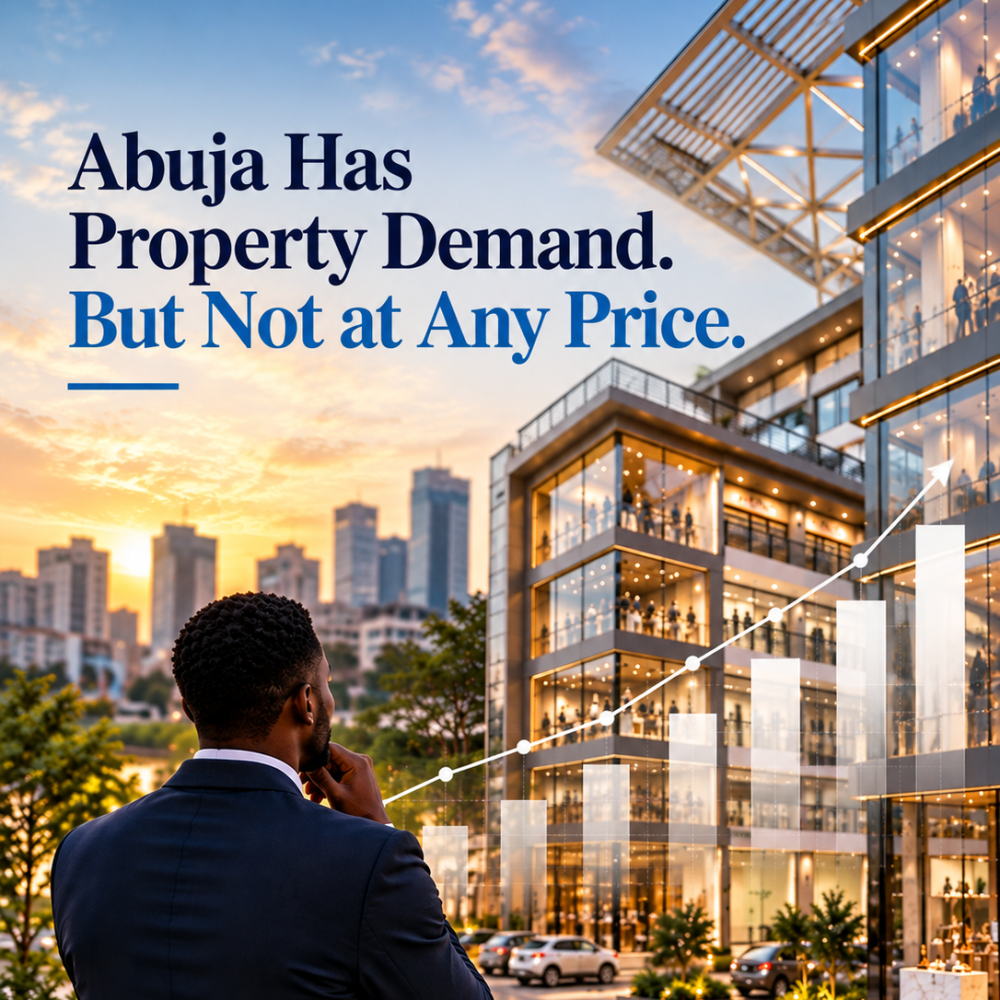
Abuja’s real estate market has no shortage of interest. The more important question in 2026 is whether properties are being offered at prices the market is actually prepared to absorb.
Between 17 and 27 September 2026, Nigeria Property Centre recorded 46,562 property searches in Abuja. Yet the typical rental search budget was ₦5.9 million, compared with a ₦14 million median asking price. For properties for sale, the typical search budget was ₦171.7 million, against a ₦350 million median asking price.
The message is clear:
Demand exists. Affordability is increasingly determining where that demand goes.
An Active Market Can Still Be Price-Sensitive
High asking prices can suggest a strong market, but asking price is not the same as transaction price—or effective demand.
NPC's Q3 2026 data ranks Abuja as the most expensive market among the nine states/territories covered, with a ₦350 million median asking price across 13,241 listings. Median asking rent stood at ₦13 million per annum.
At the same time, 16.6% of Abuja rental searches returned no matching listing, compared with 9.3% for sales.
People are searching. The challenge is finding the right product at the right price.
Pricing Is Becoming Part of the Investment Strategy
NPC's Q3 data also shows that rental properties priced around their local market level generated 140.6 enquiries per 100 listings, compared with 68.1 enquiries for properties priced more than 10% above the local median.
The implication for landlords, developers and investors is straightforward:
The highest asking price does not necessarily produce the strongest-performing property.
A commercially sensible asset must balance acquisition cost, achievable rent, location, quality, operating costs and the depth of its potential occupier market.
Commercial Property Matters Too
Abuja's commercial market is evolving alongside its residential market. NPC puts the median advertised rent for commercial property in Abuja at approximately ₦10 million per annum, based on 519 listings in its Q3 report.
Estate Intel also points to a more diversified Abuja market, with retail, hospitality, mixed-use and commercial developments expanding the city's business ecosystem. For occupiers, factors such as accessibility, infrastructure, security, building quality, amenities and flexibility are becoming increasingly important alongside location.
Recent development activity reinforces this trend. BusinessDay reported a partnership for Phase Two of the Dei-Dei Ultra-Modern Market, with developers citing demand for commercial space from investors, entrepreneurs and businesses.
So the commercial-property question is no longer simply:
“Will Abuja businesses need space?”
They will.
The more important question is:
“What kind of space will businesses be willing and able to pay for?”
What Should Investors Be Watching?
Investors should look beyond headline appreciation and consider:
- Is the price supported by comparable properties?
- Who is the likely tenant or buyer?
- What can that occupier realistically afford?
- Can the property accommodate different uses?
- How accessible is it to customers and employees?
- What additional costs come with occupation?
- Is demand driven by actual economic activity or future expectations?
Abuja is experiencing strong property interest alongside significant affordability pressure. Infrastructure improvements are also opening up previously overlooked districts and influencing development activity across the FCT.
The opportunity, therefore, may not simply be in buying the most expensive property in the most established location.
It may be in identifying well-connected locations where price, product and emerging demand still make sense together.
Abuja property demand remains active, but a sizeable gap has emerged between asking prices and the budgets buyers and renters are searching with. For investors and developers, 2026 is increasingly a market where pricing, location, usability and occupier affordability need to work together.